Air Dome vs Permanent Building Comparison
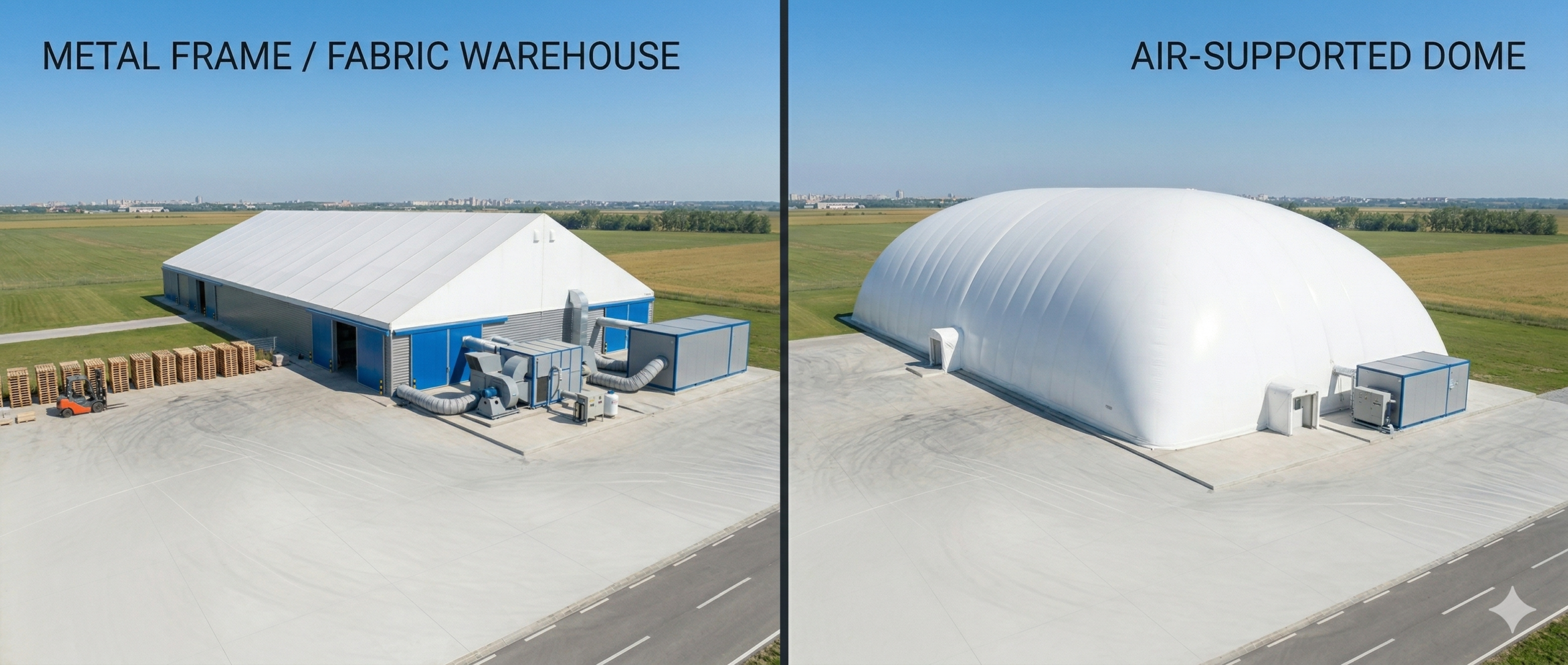
You’re facing a critical decision that’ll impact your facility for years to come. Air domes promise quick installation and lower upfront costs, while permanent buildings offer long-term value and stability. The $700,000 versus $2 million price difference seems straightforward, but there’s more beneath the surface. Hidden operational costs, maintenance expenses, and property value implications can completely flip your initial calculations. Before you commit to either option, you need to understand what these numbers really mean for your specific situation.
Air Dome Vs Permanent Building: Complete Cost Comparison
When you’re evaluating a 20,000 square foot facility, the cost difference between air domes and permanent buildings becomes strikingly apparent.
You’ll spend approximately $700,000 for an air dome versus $2 million for a permanent structure—that’s 50-75% savings upfront. This air dome vs permanent structure comparison reveals significant financial advantages for budget-conscious projects.
Your installation timeline differs dramatically too. Air domes require just 2-6 weeks compared to 12-18 months for traditional construction.
This temporary vs permanent facility comparison shows air domes offer immediate functionality without lengthy delays.
However, permanent buildings provide long-term value through increased property worth and lower operating costs.
The inflatable vs traditional building decision ultimately depends on your budget constraints. If you’re working with less than $1 million, air domes present the most viable solution.
Installation Speed: 2-Week Air Domes Vs 18-Month Construction
While permanent buildings trap you in lengthy construction cycles, air domes deliver operational facilities in a fraction of the time.
When comparing air dome vs building installation speed, you’ll find dramatic differences that impact your project timeline and cash flow.
Air domes require just 2-6 weeks for complete installation. You’ll have your facility operational within a month, generating revenue immediately.
The streamlined process involves site preparation, foundation work, and dome inflation – no complex structural work needed.
Permanent buildings demand 12-18 months of construction time. You’ll face permit delays, weather interruptions, and material shortages that extend timelines.
Complex structural work, electrical systems, and finishing touches create bottlenecks.
This speed advantage means you’ll start operations 15 months earlier with air domes, maximizing your return on investment.
When Air Dome Flexibility Beats Permanent Structures
Beyond speed advantages, air domes provide operational flexibility that permanent structures simply can’t match. You can relocate your dome when needs change, whether moving to a better location or following seasonal demand patterns.
| Flexibility Factor | Air Dome | Permanent Building |
|---|---|---|
| Relocation | Move anywhere with proper permits | Fixed location permanently |
| Seasonal Use | Deflate during off-seasons | Year-round maintenance costs |
| Expansion | Easy size modifications | Requires major construction |
| Purpose Changes | Quick reconfiguration | Costly renovations needed |
If you’re running sports camps, seasonal training programs, or temporary events, this adaptability becomes invaluable. You’re not locked into a single use case or location for decades. This flexibility particularly benefits organizations with changing needs or those testing market demand before committing to permanent infrastructure investments.
Long-Term Costs: Air Dome Operations Vs Permanent Maintenance
You’ll face different cost structures when operating air domes versus maintaining permanent buildings over time.
Air domes require continuous energy for inflation and climate control, while permanent structures need periodic repairs, HVAC maintenance, and eventual roof replacements.
Your long-term financial picture depends on balancing these ongoing operational expenses against traditional building maintenance cycles.
Annual Operating Expenses
Although air domes cost considerably less upfront, you’ll face higher annual operating expenses compared to permanent buildings. Your air dome requires continuous electricity to maintain structural integrity through constant air pressure, typically consuming 20-30% more energy than heating a comparable permanent facility.
Your main ongoing costs include:
- Blower system maintenance – Regular filter changes, motor servicing, and backup system checks
- Higher insurance premiums – Specialized coverage for air-supported structures costs 15-25% more annually
- Membrane replacement – Every 12-15 years, you’ll need fabric replacement costing $150K-$200K
- Emergency repairs – Weather damage, tears, or equipment failures require immediate professional response
Despite these higher operating costs, most facilities still save money overall due to the dramatically lower initial investment.
Maintenance Cost Breakdown
Breaking down maintenance costs over a 20-year period reveals significant differences between air domes and permanent buildings.
You’ll spend approximately $15,000-25,000 annually maintaining an air dome, primarily on fabric repairs, blower system upkeep, and energy costs for continuous pressurization.
Your permanent building maintenance averages $8,000-15,000 yearly, focusing on HVAC systems, roofing, and structural elements.
However, you’ll face major fabric replacement every 15-20 years with air domes, costing $200,000-300,000.
Permanent structures require periodic roof replacement ($150,000-200,000) every 25-30 years but offer superior durability.
Your total 20-year maintenance investment typically reaches $500,000-800,000 for air domes versus $400,000-600,000 for permanent buildings.
See How It Works for Your Facility
Use our interactive configurator to design your perfect air dome, get instant pricing, and visualize your space in 3D—all in under 5 minutes.
Explore ConfiguratorWhile permanent structures cost less long-term, air domes provide flexibility that may justify higher maintenance expenses.
Energy Efficiency Comparison
When comparing energy efficiency between air domes and permanent buildings, the continuous pressurization system becomes your largest operational expense. Air domes require 24/7 blower operation to maintain structural integrity, consuming considerable electricity year-round.
However, their superior insulation properties often offset this cost during heating and cooling seasons.
Energy efficiency factors to evaluate:
- Air dome blowers consume 15-25 kW continuously, adding $15,000-30,000 annually to electricity bills
- Double-membrane insulation in air domes provides R-values of 8-12, reducing HVAC loads by 30-40%
- Permanent buildings eliminate pressurization costs but may require more heating/cooling due to thermal bridging
- Climate impact varies greatly – air domes excel in moderate climates but struggle in extreme temperatures
Your location’s utility rates and climate conditions ultimately determine which option delivers better long-term energy efficiency.
Property Value Impact Of Air Domes Vs Permanent Buildings
If you’re evaluating facility options with resale value in mind, permanent buildings deliver markedly higher property appreciation than air domes.
Lenders and appraisers classify permanent structures as real property improvements, directly boosting your land’s assessed value and marketability. You’ll see this reflected in higher property tax assessments, but also substantial equity gains over time.
Air domes, conversely, don’t enhance property values since they’re considered temporary installations. Banks won’t factor them into property valuations for refinancing or sales purposes.
However, this distinction works both ways – you won’t face increased property taxes with an air dome.
Your choice depends on investment strategy. If you’re planning to sell within 5-10 years, permanent construction offers better ROI through appreciation.
For shorter-term needs, air domes preserve capital flexibility.
Space Size Requirements For Air Dome Vs Permanent Options
Beyond financial considerations, the physical footprint requirements differ considerably between air domes and permanent buildings.
You’ll find that air domes offer remarkable flexibility in sizing and placement that permanent structures simply can’t match.
Here’s how space requirements compare:
- Minimum viable size – Air domes work efficiently from 5,000 sq ft up, while permanent buildings become cost-effective around 15,000 sq ft.
- Site preparation – You’ll need minimal ground work for air domes versus extensive foundation excavation for permanent structures.
- Expansion capability – Air domes can’t be expanded, but you can relocate them; permanent buildings allow additions but at significant cost.
- Irregular lot accommodation – Air domes adapt better to oddly-shaped properties since they don’t require traditional foundation layouts.
Your available space directly impacts which option makes financial sense.
Budget Under $1M? Why Air Domes Win Every Time
Why do air domes dominate the sub-$1M market so decisively?
You’re looking at a $700K air dome versus a $2M permanent structure for 20,000 square feet – that’s 65% less upfront investment.
You’ll get your facility operational in 2-6 weeks instead of waiting 12-18 months for construction completion.
Your budget constraints make this decision straightforward.
While permanent buildings offer long-term value and prestige, you can’t justify spending triple the cost when you’re working within financial limits.
Air domes deliver immediate functionality without the massive capital commitment.
You’re also getting flexibility that permanent structures can’t match.
If your needs change or you want to relocate, you’re not stuck with an immovable asset.
For budget-conscious projects, air domes eliminate the financial risk while providing the space you need.
Air Dome Vs Permanent Building: Which Fits Your Needs?
How do you determine whether an air dome or permanent building aligns with your specific project requirements? Your decision hinges on four critical factors that’ll shape your investment’s success.
- Timeline urgency – Need facility operational within 2-6 weeks? Air domes deliver fast deployment versus 12-18 months for permanent construction.
- Budget constraints – Working with under $1M? Air domes cost $700K compared to $2M for permanent structures, saving you 50-75%.
- Usage flexibility – Require seasonal operation or future relocation? Air domes offer adaptability that permanent buildings can’t match.
- Long-term vision – Planning for property value appreciation and prestige? Permanent buildings provide lasting investment returns despite higher upfront costs.
Match these factors against your priorities to make the right choice.
Ready to Take the Next Step?
Schedule a free consultation with our experts. We'll review your site, answer your questions, and provide a detailed proposal tailored to your needs.
Book Free Consultation