Tension Fabric Structure vs Air Dome Cost
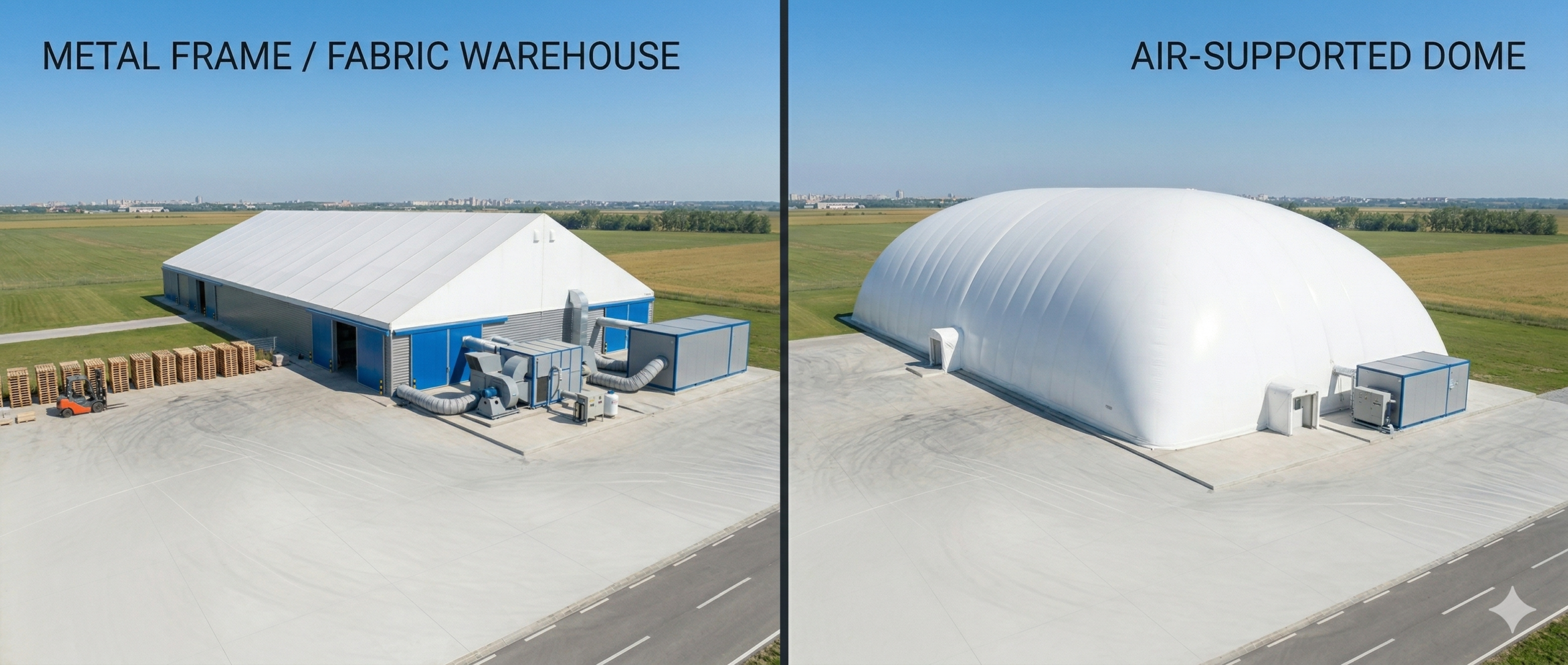
You’ll pay 50-75% less upfront for an air dome ($80,000-$400,000) compared to a tension fabric structure ($150,000-$800,000), but the air dome’s annual operating costs of $300,000+ will quickly eliminate those initial savings. Air domes require constant blower operation costing $1,500-$3,500 monthly, while tension fabric structures need minimal maintenance with just standard inspections. Over ten years, you’re looking at potentially $2.85-$5.7 million in operational expenses for large air domes, making the total cost comparison more complex than initial pricing suggests.
Initial Investment: Tension Fabric Vs Air Dome Construction Costs
When comparing initial construction investments, tension fabric structures typically require $150,000-$800,000 upfront, while air domes cost considerably less at $80,000-$400,000.
The tension fabric vs air dome cost difference stems from structural complexity and materials. Rigid frame vs inflatable cost variations reflect engineering requirements—tension systems need permanent steel frameworks, while air domes rely on continuous inflation systems.
You’ll find tension fabric buildings range from $15-$35 per square foot installed, depending on features and complexity. Basic kits start around $10-$15 per square foot for materials only. These structures also save significantly on labor costs since fabric installation requires only 0.02-0.03 man-hours per square foot.
Installation requires 8-20 weeks compared to air domes’ 2-6 weeks timeline.
Permanent vs seasonal dome cost considerations affect your decision—tension structures offer long-term durability, while air domes provide cost-effective temporary solutions with lower upfront investment but higher operational dependencies.
Why Air Domes Require $300K+ In Annual Operating Costs
While the $300,000+ annual operating cost figure may seem intimidating, it’s important to understand this represents large-scale air dome facilities rather than a universal baseline. Your actual costs depend entirely on facility size, calculated at $3–$6 per square foot annually. A 100,000 square foot dome reaches this $300K+ threshold, but smaller facilities cost considerably less.
In fabric structure vs bubble comparison, operating expenses differ dramatically. Air domes require continuous inflation ($0.10–$0.20 per square foot yearly) plus utilities ($0.50–$1.50 per square foot). Installation costs vary significantly, with small domes requiring as few as 4 days while larger structures may take several weeks.
Meanwhile, tension fabric structures eliminate inflation costs entirely, reducing monthly operating expenses to $800–$2,000 versus air domes’ $1,500–$3,500.
You’ll find smaller air dome projects, like three-court tennis facilities, typically incur $60,000–$80,000 annually when operating seasonally.
Tension Fabric Maintenance Vs Air Dome Membrane Replacement
Since tension fabric structures use permanent steel frameworks with replaceable membrane panels, you’ll face entirely different maintenance scenarios compared to air domes that rely on continuous pressurization and full membrane systems.
Your tension fabric structure’s steel frame requires minimal maintenance beyond standard inspections and occasional hardware adjustments. When membrane panels need replacement, you can replace individual sections rather than entire coverings, keeping costs manageable.
Air domes demand constant blower operation, creating $1,500-3,500 monthly operating costs versus tension fabric’s $800-2,000 range.
You’ll face higher energy bills and mechanical system maintenance with air domes. Membrane replacement becomes more complex since the entire structure deflates during repairs. Fabric repair costs average $2 per square foot, making maintenance more predictable and affordable than traditional alternatives.
Tension fabric structures offer superior long-term TCO through their permanent frameworks and selective panel replacement capabilities, eliminating continuous pressurization costs that plague air dome operations.
When Air Domes Beat Tension Fabric (Size And Span Limits)
Although tension fabric structures dominate most long-term comparisons, air domes excel in specific scenarios where maximum clear spans and rapid deployment matter more than permanent infrastructure.
You’ll find air domes advantageous when you need immediate coverage for massive areas without structural constraints.
Air-supported structures provide completely unobstructed interiors without internal columns or support beams, making them ideal for aircraft hangars, sports complexes, or temporary warehousing.
You can scale height with minimal additional air supply, creating cost-effective volume expansion that’s harder to achieve with tension fabric.
When you’re facing tight installation deadlines, air domes win with 2-6 week deployment versus 8-20 weeks for tension fabric.
For projects requiring maximum open space with minimal structural interference, air domes deliver superior span capabilities despite higher operating costs. However, storm damage and maintenance expenses can significantly impact the total cost of ownership over time.
Installation Speed: Why Tension Fabric Saves Months And Money
You’ll cut your installation timeline dramatically when you choose tension fabric structures over air domes – we’re talking 8-20 weeks versus potentially longer timelines for more complex installations.
The lightweight materials mean you won’t need heavy machinery or large crews, slashing your labor costs while crews can work efficiently in most weather conditions. Unlike air domes that require continuous inflation around the clock, tension fabric structures eliminate ongoing operational demands during construction.
When you’re facing tight project deadlines, tension fabric’s pre-engineered components arrive ready for quick assembly, helping you open your facility months earlier than traditional construction methods.
Lightweight Construction Advantages
When comparing construction timelines, tension fabric structures deliver your facility in months rather than years, offering a compelling advantage over traditional building methods.
You’ll benefit from dramatically reduced weight requirements that streamline every phase of construction.
The lightweight design creates multiple cost-saving opportunities:
- Minimal foundation work – You’ll avoid extensive concrete pads and soil stabilization requirements.
- Reduced labor intensity – Installation requires only $0.02-$0.03 man-hours per square foot versus $0.04-$0.07 for steel sheeting.
- Simplified site preparation – Smaller construction footprints reduce overall site disruption and preparation costs.
- Faster equipment deployment – Pre-fabricated components arrive ready for assembly without heavy machinery needs.
You’ll save thousands in equipment rental costs while meeting critical project deadlines through compressed schedules.
Reduced Labor Requirements
Since tension fabric structures require only $0.02 to $0.03 man-hours per square foot compared to steel sheeting’s $0.04 to $0.07 requirement, you’re looking at immediate labor cost reductions of 50-70%. This efficiency stems from prefabrication in controlled factory environments rather than extensive on-site assembly.
| Structure Type | Installation Timeline | Labor Requirements |
|---|---|---|
| Tension Fabric | 8-20 weeks | Minimal on-site crew |
| Air Domes | 2-6 weeks | 1-2 day installation |
| Traditional Steel | Months to years | Extended skilled labor |
Air domes complete nearly all assembly off-site, requiring only days for final installation. You’ll eliminate extended construction crew management costs while generating revenue sooner. The Regis University Berce Athletic Center exemplifies this efficiency, completing construction in four months versus traditional facilities requiring years.
Meeting Tight Deadlines
Beyond labor savings, meeting aggressive project deadlines often determines whether your facility generates revenue this season or next year.
While air domes appear faster with 2-6 week installation windows, you’re overlooking critical timeline factors that make tension fabric structures the smarter choice for deadline-driven projects.
Here’s why fabric structures consistently deliver predictable completion dates:
- Weather resilience – No deflation cycles or storm-related reconstruction delays that plague air domes
- Permit efficiency – Streamlined approval process compared to air dome complications
- Year-round operation – Immediate revenue generation without seasonal weather closures
- Predictable scheduling – 6-8 month timeline includes design, manufacturing, and installation without weather interruptions
You’ll generate revenue faster with a structure that operates continuously rather than one requiring expensive reconstruction after every major storm.
Total 10-Year Ownership Costs For Both Structure Types
When you’re evaluating fabric structures versus air domes, the initial price tag only tells part of the story.
See How It Works for Your Facility
Use our interactive configurator to design your perfect air dome, get instant pricing, and visualize your space in 3D—all in under 5 minutes.
Explore ConfiguratorYou’ll need to factor in a decade’s worth of operating expenses, maintenance costs, and potential storm damage repairs to understand the true financial impact.
Your total cost of ownership analysis should compare upfront investments against long-term operational expenses to determine which structure delivers better value over ten years.
Initial Investment Comparison
While air domes present an attractive initial price point of $10-$25 per square foot compared to tension fabric structures at $25-$45 per square foot, this upfront advantage doesn’t tell the complete financial story.
Your initial investment breakdown reveals significant differences:
- Air dome projects range from $100,000-$2,500,000, with basic facilities starting around $100,000-$200,000.
- Tension fabric structures span $250,000-$5,000,000+, with mid-range projects typically $250,000-$1,250,000.
- Air domes cost 50-75% less than permanent buildings initially, making them appear budget-friendly.
- Frame-supported fabric structures command premium pricing but offer superior long-term durability.
You’ll find air domes cheaper upfront, but this initial savings creates a false economy when you factor in decade-long operational expenses and replacement cycles.
Operational Cost Analysis
The operational cost gap between these structures widens remarkably over time, turning air domes‘ initial savings into a financial liability. You’ll pay $3–$6 per square foot annually for air dome operations versus considerably lower expenses for tension fabric structures.
Over ten years, this translates to $30–$60 per square foot in cumulative operational costs for air-supported buildings.
Consider a 95,000-square-foot facility: you’re looking at $2.85–$5.7 million in total operational expenses over a decade for air domes. Continuous inflation requirements drive these costs through 24/7 blower electricity consumption and substantial energy losses during entry/exit cycles.
Meanwhile, tension fabric structures offer superior thermal efficiency through custom insulation options and eliminate continuous pressurization costs, creating compound savings that increasingly favor frame-supported alternatives.
Which Building Type Delivers Better Long-Term Value?
Although air domes tempt buyers with their lower upfront costs of $100,000 to $2,500,000 compared to tension fabric structures at $250,000 to $5,000,000+, you’ll discover that initial savings quickly evaporate under the weight of relentless operational expenses.
Over 10-20 year periods, tension fabric structures consistently deliver superior value through:
- Energy efficiency – Natural daylighting and superior insulation slash HVAC costs compared to single-skin air domes.
- Durability advantages – 25-year warranties versus frequent air dome replacements reduce lifecycle expenses.
- Operational stability – Fixed monthly costs of $800-$2,000 versus air domes’ escalating $1,500-$3,500 inflation expenses.
- Weather resistance – Hurricane-rated materials withstand extreme conditions without structural compromise.
You’re investing in long-term financial performance when choosing tension fabric over short-term air dome savings.
Frequently Asked Questions
Can Tension Fabric Structures Withstand Extreme Weather Like Hurricanes and Heavy Snow?
Yes, you can rely on tension fabric structures to withstand extreme weather when they’re properly engineered.
You’ll find they handle Category III hurricane winds up to 150 mph with robust anchoring systems and tie-down cables.
They’re designed to meet building codes for heavy snow loads through proper fabric tensioning and curvature distribution.
You’ll need PTFE-coated materials and deep foundations, but they’ll provide reliable protection against hurricanes and snow when professionally installed.
What Financing Options Are Available for Large-Scale Fabric Structure Projects?
You’ll find several financing options for your large-scale fabric structure project.
Traditional commercial real estate loans offer competitive rates with longer repayment terms.
Lease-to-own programs provide tax-deductible payments with easier approval processes.
You can access 100% financing coverage including installation costs with zero down payment options.
SBA 7(a) loans deliver lower interest rates, while equipment financing uses your structure as collateral for faster approval and better terms.
Do Building Codes Require Special Permits for Air Dome Installations?
Yes, you’ll need special permits for air dome installations.
Building codes classify air-supported structures under International Building Code Chapter 31 as Special Construction, requiring structural engineer approval and stamped drawings.
You must demonstrate compliance with local wind, snow load, and seismic requirements.
Additionally, you’ll need fire safety systems, emergency egress doors, mandatory airlocks with dual entry points, and smoke detection systems before permit approval.
How Do Energy Costs Compare Between Fabric Structures and Air Domes?
You’ll find fabric structures offer significant energy savings through natural daylighting that virtually eliminates artificial lighting during daytime hours.
Air domes require continuous energy for maintaining inflation pressure, costing $3-6 per square foot annually.
However, both structures provide superior insulation compared to metal buildings, reducing your HVAC costs year-round.
Fabric structures don’t need ongoing structural energy expenses, while air domes require constant power for air supply systems throughout their operational lifespan.
Can Existing Buildings Be Converted to Tension Fabric or Air Dome Systems?
You can’t convert existing buildings to tension fabric systems since they require complete structural redesign from the ground up.
However, you can retrofit air dome systems over existing structures like sports courts or pools, providing weather protection while preserving the original building.
Air domes offer more conversion flexibility with their inflatable design, though you’ll still need structural assessments and proper anchoring systems to guarantee safety and code compliance.
Ready to Take the Next Step?
Schedule a free consultation with our experts. We'll review your site, answer your questions, and provide a detailed proposal tailored to your needs.
Book Free Consultation